Dear Partners,
Getting Down to Facts III (GDTF III), the third iteration of a collaborative research initiative working to provide the strongest possible evidence for improving the TK-12 public education system in California, is officially underway!
We are in a pivotal moment for the state. The pandemic recovery continues, we’re experiencing rapid technological change, and 2026 elections will bring new state leadership. GDTF III aims to bring clarity, evidence, and direction to the most urgent questions facing California schools today and beyond.
This is our first in a series of GDTF III updates sharing early research and opportunities. This is the right moment to invite your colleagues to receive future updates about the project.
In this update, we share insights into the Getting Down to Facts project, focusing on:
- Getting Down to Facts Overview
- The Research Agenda
- Community Engagement
- Researcher Profiles: Julie Marsh and James Bridgeforth
Getting Down to Facts Overview
Getting Down to Facts is a set of research studies examining the state of California education, drivers of success and challenge, and potential paths forward to benefit students. First launched in 2007 and then revisited in 2018, the Getting Down to Facts project has successfully helped chart a course toward more equitable and effective schooling in California. Previous iterations of Getting Down to Facts have inspired major reforms in school finance, governance, and early childhood education. You can learn more about the legacy of Getting Down to Facts on our website.
Our public schools are contending with the aftershocks of the COVID-19 pandemic, the rise of artificial intelligence and other emerging technologies, and increasing social and political polarization. Rigorous, timely, and actionable research deeply grounded in the realities of California’s students, families, and educators can help us to meet this moment. Leveraging the work of over 50 researchers, GDTF III builds on a legacy of impact with a forward-looking agenda designed to help California become a national model of educational excellence.
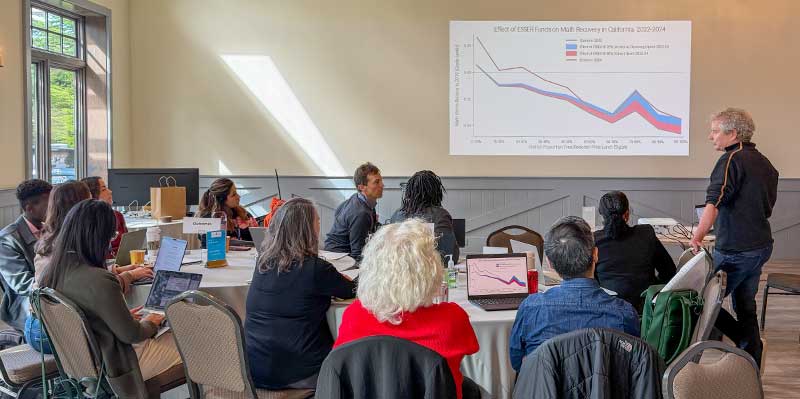
Sean Reardon, Stanford University, discussed Trends and Patterns of Academic Performance in CA, 2003-2024
The Research Agenda
This iteration of GDTF III is focusing on four overarching research questions:
How are California’s students and schools doing? Where are we succeeding, and where are we falling short?
How can California deliver high-quality instruction for all students and respond with excellence to changing needs and opportunities?
What supports are most effective for multilingual learners, who now represent nearly half of our student population?
How can new technologies transform learning experiences to be more effective and more engaging?
These questions are the foundation of over 30 coordinated research studies ranging in scope, methods, and disciplines that together will provide a comprehensive picture of California’s TK-12 public school system.
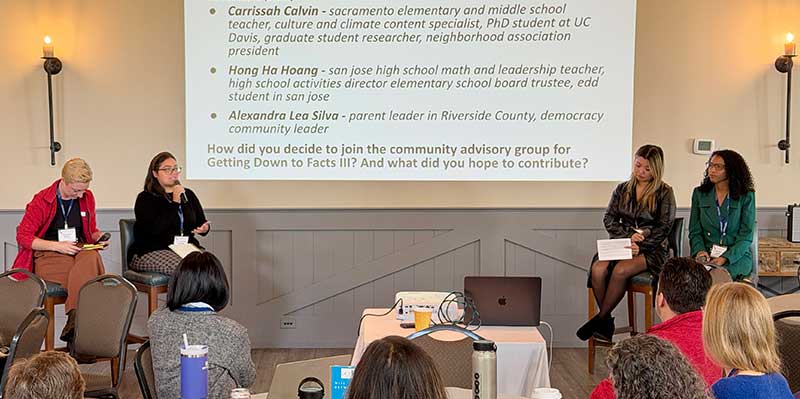
GDTF III Advisory Group Panel: Carrissah Calvin, Hong Ha Hoang, Alexandra Lea Silva, and Briana Mullen
Community Engagement
Our commitment to including California educators, students, and caregivers underlies our approach to this research initiative. In early 2025, we launched a statewide listening tour, connecting with over 20 key stakeholder groups. Their insights provided a foundation to help shape the research agenda.
Additionally, three formal Community Advisory Groups, composed of students, parents and caregivers, and educators, will meet from August 2025 to April 2026 to ensure that the research is grounded in lived experiences and informed by those directly impacted by education policy.
Through workshops, digital tools, policy briefs, and community forums, we aim to ensure that the knowledge we build together makes its way into school board meetings, parent and teacher sessions, and legislative hearings.

James Bridgeforth, University of Delaware, discussed School Board Governance
Researcher Profiles
A diverse group of over 50 researchers from institutions in California and across the US are contributing research to Getting Down to Facts III. In this update, we hear from Dr. Julie Marsh and Dr. James Bridgeforth, from the University of Southern California (USC) and the University of Delaware respectively, who are lead researchers on a study of local school boards. Dr. Marsh participated in GDTF I and GDTF II, and is back for GDTF III. Dr. Bridgeforth is new to the project. Beth Schueler (Stanford University), Miguel Casar (University of Alabama), Akunna Uka (USC), Laura Mulfinger (USC), Amanda Pickett (University of Delaware), Jeimee Estrada-Miller (USC), Mariana De Franca Steil (USC), and Jacob Alonso (USC) round out the team on this study.
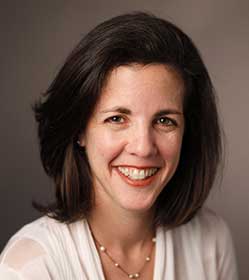
Julie Marsh
Professor of Education, University of Southern California
Julie Marsh
Why are you excited to contribute to Getting Down to Facts III?
I’m looking forward to contributing to an in-depth examination of local governance for GDTF III. As a state that has invested heavily in “local control,” it is critical to understand the day-to-day realities of school board members whose decisions can greatly affect local policy and practice.
As part of GDTF III, we’ve launched a statewide survey of school board members. These data combined with interviews and cases will provide depth and breadth to our understanding of local governance.
Tell us about your research.
We are examining how school board members are experiencing and navigating the current socio-political context. We are asking how school board members understand their roles, what challenges they face, and what additional support they need. In addition, we are interested in understanding how these beliefs relate to their feelings of self-efficacy, reported well-being, and intention to seek re-election. Ultimately, we hope these results can generate ideas for improving local governance.
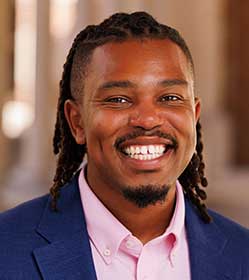
James Bridgeforth
Assistant Professor, University of Delaware
James Bridgeforth
Why are you excited to contribute to Getting Down to Facts III?
I'm excited to contribute to Getting Down to Facts III because it allows us to be more forward-thinking and solutions-focused while grounding these possibilities in rigorous, empirical research. Amidst an ever-changing series of societal challenges, this work has the potential to lead to meaningful changes in policy and practice that can strengthen our education system.
Tell us about your research.
Our research explores the ways that school board members are navigating an increasingly complex landscape for public education. Through our mixed-methods study, we aim to provide critical insights about the experiences of board members – including the challenges and constraints that they face – so that we might develop policy solutions that support an inclusive, locally-governed education system.
We invite you to subscribe to our mailing list for more updates on the Getting Down to Facts initiative. Thank you for being part of this work.
With gratitude,
The Getting Down to Facts III Team