
This agenda is intended to guide research investments by government agencies, foundations, and research teams seeking to generate evidence that can shape policy, practice, and technology development in education. It asks under what conditions AI should and should not be used to support students and educators and, where it helps, what educational systems must change to make it accessible and useful. A complementary agenda from CRPE takes up the adjacent question of how policymakers, system leaders, and funders can use that evidence to guide transformation.
Research in Action
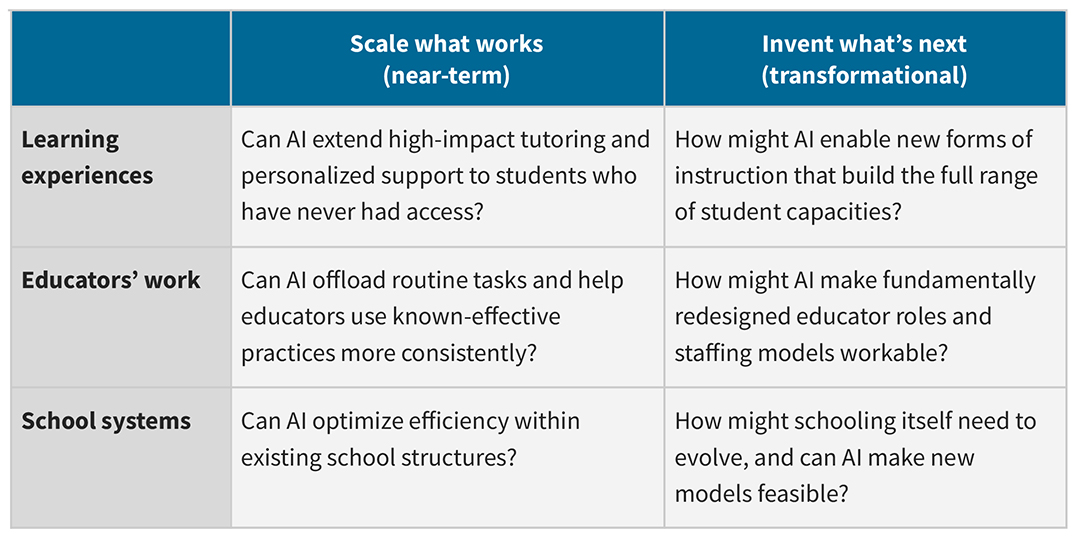
AI adoption is moving faster than the evidence. A recent review identified more than 800 studies relevant to AI in K–12 education, but only a small fraction provide strong causal evidence. System leaders are choosing tools and setting procurement, governance, staffing, and instructional policies that may shape students’ experiences for years, even though research has already documented learning losses from some uses of AI. This agenda sets out the evidence needed to guide those decisions and expand what students can become and what educators and schools can help them achieve.
Evidence Base Review -
The causal evidence on generative artificial intelligence (AI) in education has grown substantially since our March 2026 Evidence Base Review. This update examines new randomized controlled trials and quasi-experimental designs in the AI Hub for Education’s Research Repository that were published between October 2025 and June 2026. It assesses whether the new evidence supports, challenges, or extends the findings we published in March.
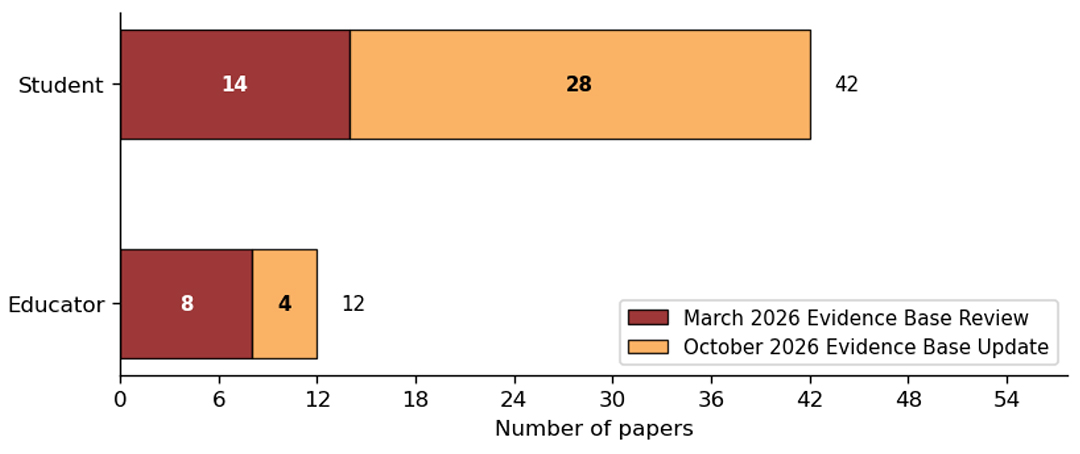
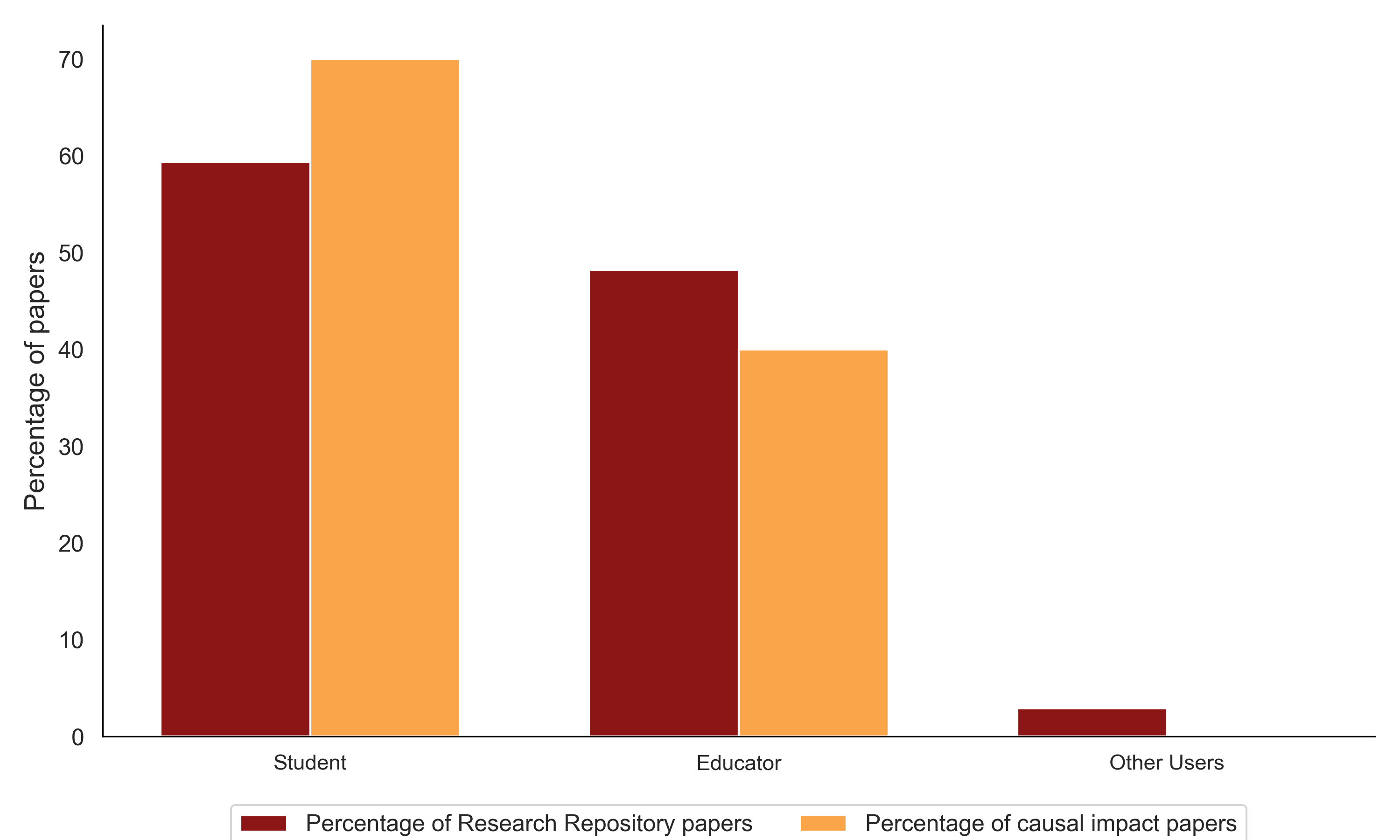
The causal evidence base on AI in education has grown substantially, from 20 papers in the March 2026 Evidence Base Review to 52 papers in this update (an increase of 32 papers). The evidence base has expanded most rapidly for student-facing AI (relative to educator-facing AI), and U.S.-based research has also increased. Five of the new student-facing studies were conducted in U.S. K–12 settings, compared with none in the March 2026 Evidence Base Review. The findings can provide guidance for education leaders, but should not be treated as broadly generalizable across U.S. K–12 settings.
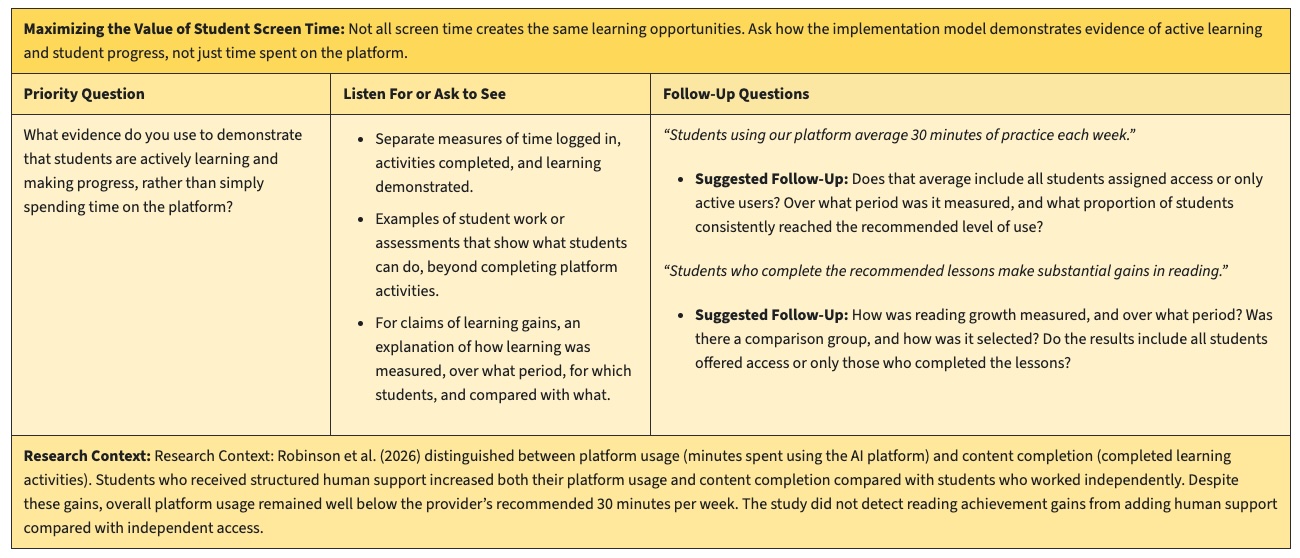
The goal of this guide is to help district leaders ask what it will take for students to consistently engage with and meaningfully benefit from an AI product in their schools. It complements existing district procurement processes by focusing on student engagement and the conditions needed to support it.
The questions are informed by Robinson et al. (2026), "Access is Not Enough: Human Support Improves Engagement with AI Tutoring." They are discussion prompts, not a product evaluation rubric.
Research Brief -
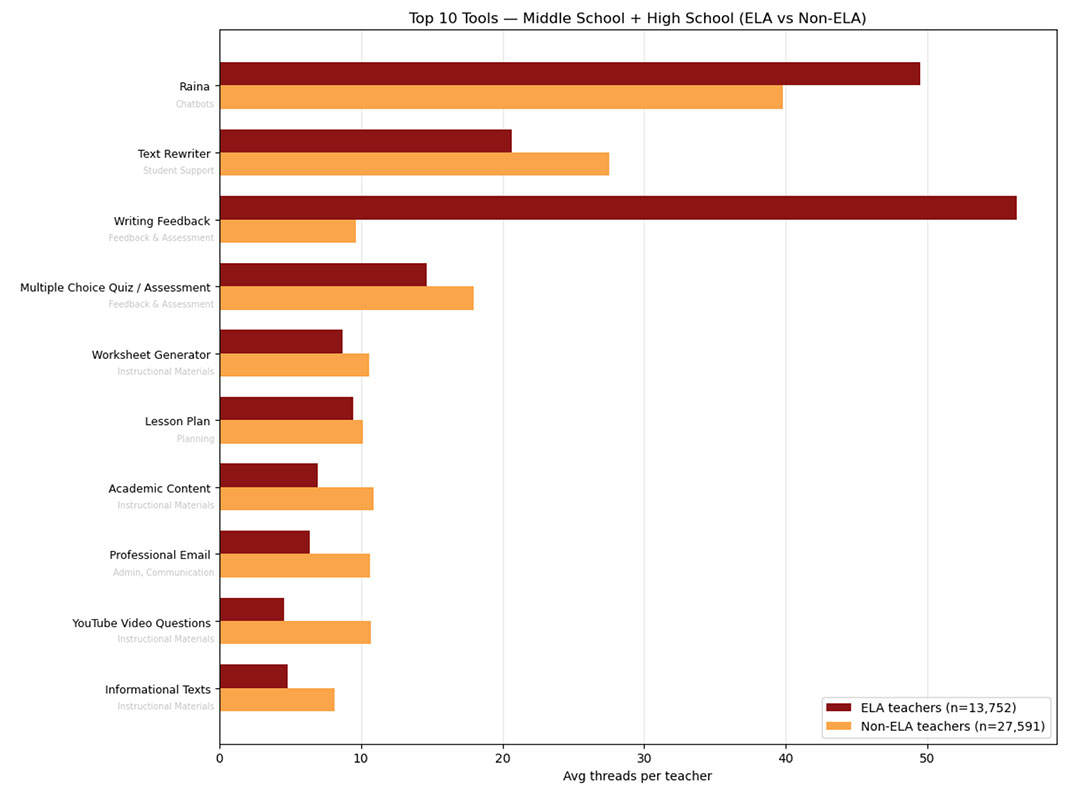
In our previous post, we analyzed a cohort of approximately 87,000 U.S. educators, representing the top 5% of MagicSchool users. We found that the multi-purpose chatbot is the most used tool in the platform and that its usage represents a similar share of threads for each grade level. Averages conceal substantial variation. The analysis established a distinct grade-level gradient in specific tool use: elementary teachers favor tools supporting communication and student support, while middle and high school teachers trend toward greater use of tools for creating instructional materials.
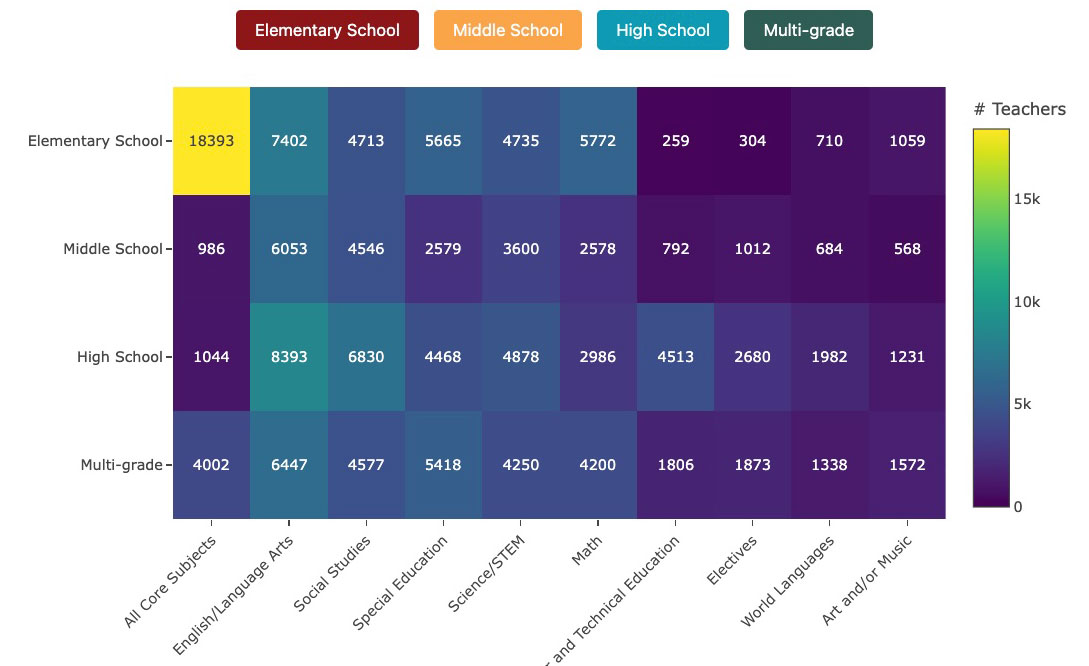
To dive deeper into use dynamics, this post focuses on the tools most used by teachers across subject areas. Since most elementary school teachers report teaching “All Core Subjects”, we restrict this analysis to a subsample of middle and high school educators who report teaching one or more specific subjects.1
We focus on the sample of roughly 41,000 power users, educators who logged 52 or more distinct days on MagicSchool since creating their account. Our analysis tracks these teachers’ activity across specific tools, such as Lesson Plan or Writing Feedback, the individual interaction threads where content is generated, and the broader functional categories used to group these workflows.
Research Brief -
Early findings from the top 5% active users
Artificial intelligence is becoming increasingly embedded in teachers' daily work. Yet we know little about how educators are using these tools and whether usage differs across teaching contexts.
This post is the first in a series examining usage patterns among highly active users of MagicSchool, one of the largest K-12 AI platforms. This first post examines how teachers are using AI tools and how these patterns differ across elementary, middle, and high school grade levels.
Using platform activity data from approximately 87,000 U.S. educators in the top 5% of MagicSchool users between May 2023 and November 2025, we explore which grade levels and subject areas these highly engaged users teach and how they interact with AI tools. Narrowing the analysis to highly active users allows us to focus on educators who have integrated these tools into their regular practice.
Research Brief -
High-impact tutoring is a highly effective, well-researched approach for accelerating student learning. Students who receive it show learning gains of three to more than 15 months across grade levels and content areas, along with improved well-being and engagement in school. Many practitioners identify strong relationships as a key driver of effective tutoring, and research suggests that relationship-building strategies, particularly consistent tutoring with the same tutor, improve student engagement, attendance, motivation, and learning outcomes.
Research Brief -
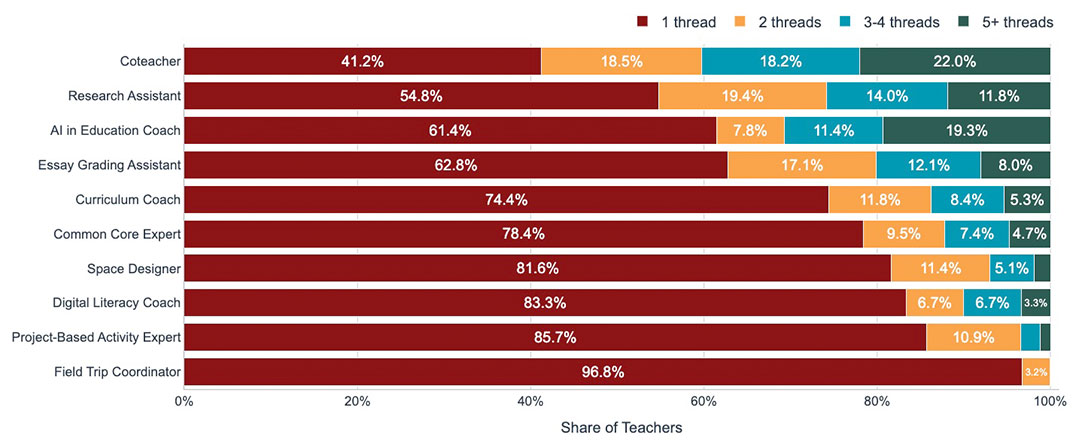
Since the launch of commercially available generative AI, the most common engagement platform is through chat. For all the appeal and flexibility of using natural language to interact with these AI models, it is not always easy to get them to generate the desired output from a question or request. For this reason, several Edtech platforms have designed custom fine-tuned education chatbots to cater to educator needs; yet, we know little about how educators are using these chat-based interfaces.
Evidence Base Review -
AI tools are arriving in schools faster than research can evaluate them. Teachers are experimenting with new tools and districts are writing policies, all while students are already using AI both inside and outside the classroom.
But for many education leaders, a basic question remains: What does rigorous research actually say about how AI affects teaching and learning?
To help answer that question, we released a new report: The Evidence Base on AI in K-12: A 2026 Review. The report reviews the current research, focusing specifically on studies that convincingly estimate causal impact, meaning studies that can tell us whether an AI tool changed outcomes for students or educators.
News and Announcements -
Education is one of AI’s most promising frontiers. With tools like ChatGPT, personalized learning support can be available to any student, anywhere, at any time.
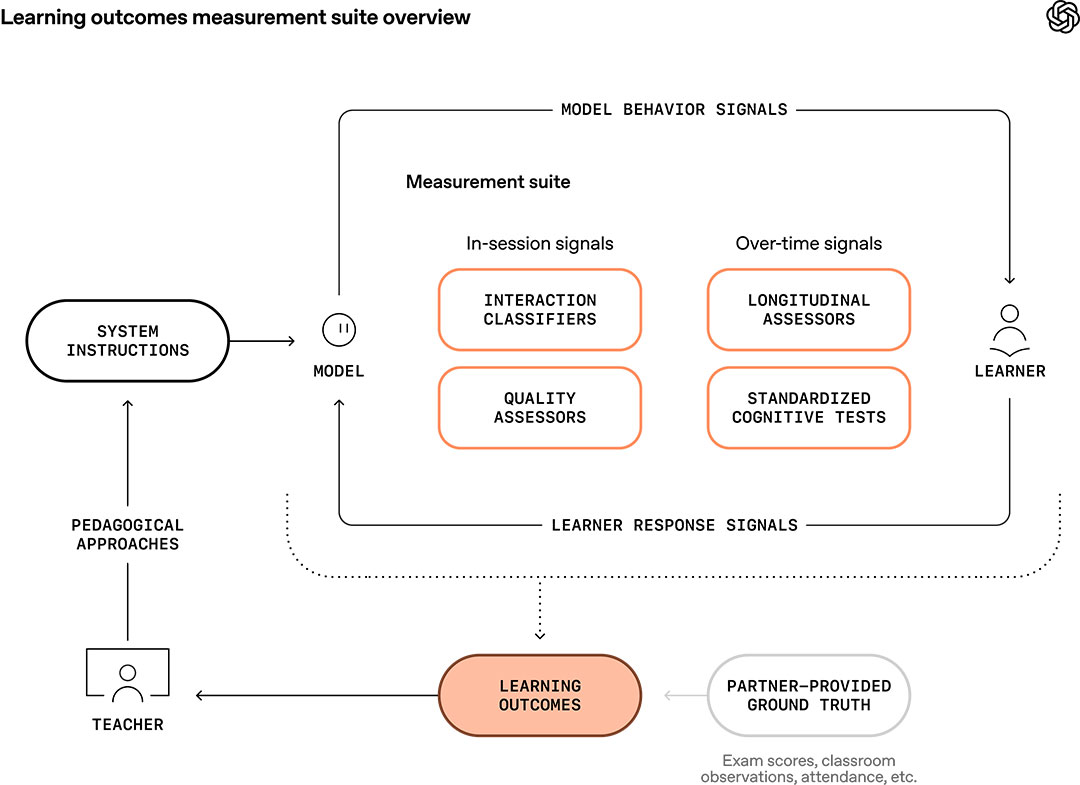
But the education sector is still early in its understanding of the impact of AI on learning outcomes. Last year, our team set out to study the use of tools like study mode and found promising gains in student performance. But our research also raised an important question: how can we assess how AI influences a learner's progress over time, not just on a final exam?
This is a broader ecosystem challenge. To-date, most research methods focus on narrow performance signals—such as test scores—and lack the ability to assess how students actually learn with AI in real-world settings, and how that use shapes outcomes over time.
